Ueki 3-layer shielding experiment (Type 3)
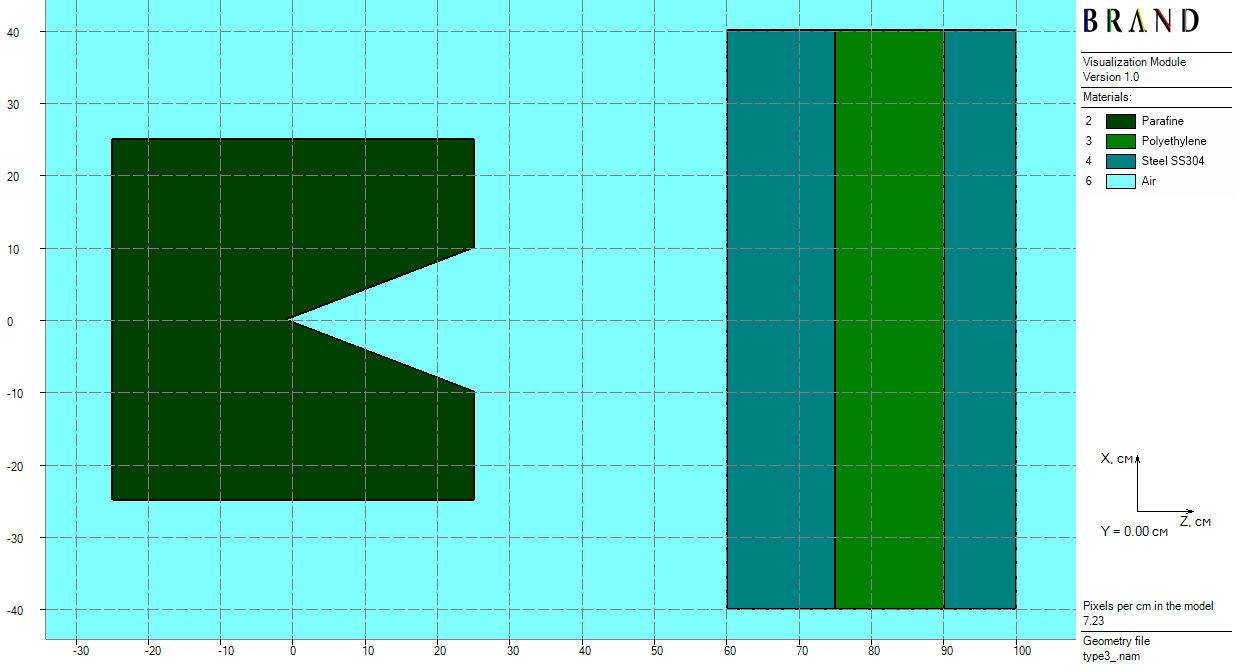

A californium-252 neutron source of intensity $5.33 \cdot 10^8$ n/s is placed into a conic paraffin collimator. The goal is computation of neutron and secondary (capture) gamma dose rates behind 3-layered shield of steel ($t$ cm) - polyethylene ($15$ cm) - steel ($25 - t$ cm) slabs, where $t$ determines the position of the polyethylene slab and can take the following values: $0$, $5$, $10$, $15$, $20$, $25$. That is, there are six computational cases in total.
 |
|---|
| Figure 1: Cross-section of the model for the case $t=15$ cm |
In this calculation, the following techniques are used:
- Expected-value estimators;
- Exponential transform (actually demanded for secondary gamma only);
- Simplified adaptive splitting.
The primary computational gain is achieved here thanks to the Simplified Adaptive Splitting and Exponential Transform (for secondary gamma) techniques.
Computed flux functional - rates of equivalent dose ANSI 77 [2].



Thicknesses of volumetric detectors are equal to 2 cm. Results of the six computations, each took approximately 3 hours, are presented in Figure 2 (see details in [3]).
|
|
(a) Neutron
|
(b) Sec. Gamma
|
References
- K. Ueki, A. Ohashi, Nobuteru Nariyama, S. Nagayama, T. Fujita, K. Hattori, and Y. Anayama. Systematic evaluation of neutron shielding effects for materials. Nuclear Science and Engineering, 124:455-464, 10 1996.
- American National Standard: neutron and gamma-ray ux-to-dose rate factors. American Nuclear Society, United States, 1977.
- V.G. Mogulian. An approach to radiation shielding evaluations using estimators by expected scoring. 2025. doi:10.5281/zenodo.16781416.